pip Printed ERROR and Exited 0
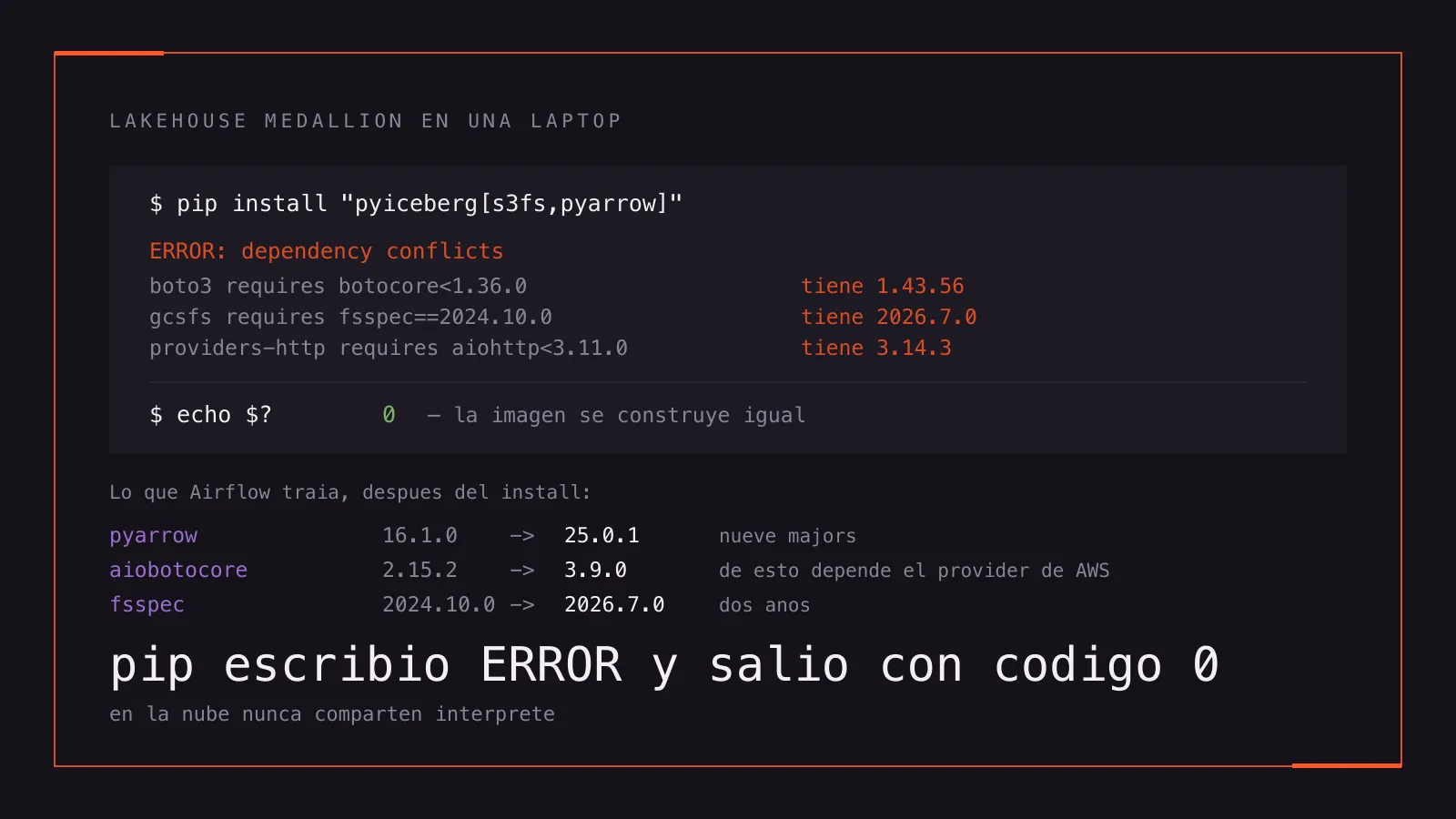
pip Printed ERROR and Exited 0
The thesis
A lakehouse that runs entirely on your laptop is sold as the cheap version of one in the cloud. Same layers, same interfaces, no bill. And that’s largely true: compute is enough, storage is enough, the mental model carries over.
What doesn’t carry over is the isolation.
In the cloud, the orchestrator and the engine that writes your tables are two managed services. They run on different machines, in different runtimes, with different dependency resolvers. They never meet. You didn’t design that isolation — it comes included, which is why it shows up on no diagram.
Bring the stack down to a single machine and the gift ends. And the thing that
manages what’s left — pip — can violate three declared constraints, print the
word ERROR three times, and exit 0.
The stack
A textbook medallion lakehouse, Bronze → Silver → Gold, with every cloud piece swapped for a local equivalent that speaks the same protocol:
| Role | In the cloud | Here |
|---|---|---|
| Object storage | S3 / ADLS | MinIO (S3-compatible) |
| Query engine | Spark / Snowflake | DuckDB |
| Table format | Delta / Iceberg | Apache Iceberg |
| Catalog | Glue / Unity | Lakekeeper (REST) |
| Orchestration | Managed Airflow | Apache Airflow |
| Transformation | dbt | dbt |
MinIO speaking S3 is what makes the exercise worth doing: the code that reads and writes has no idea it isn’t in the cloud. dbt materializes Silver and Gold as external parquet straight to object storage —
{{ config(materialized='external', location='s3://silver/int_ventas_limpias.parquet') }}— and DuckDB loads httpfs and points its S3 endpoint at minio:9000. None of
this is a trick. It’s the same configuration you’d use against a real bucket,
with a different URL.
Up to here, everything works exactly as advertised.
The step that didn’t fit
The last increment was publishing the Gold product as an Iceberg table in a REST catalog, to get ACID, time travel and schema evolution. The writer is a PyIceberg script: it reads the Gold parquet and writes the table.
The design question answers itself. Where does a pipeline step go? In the orchestrator. That’s what Airflow is for: it’s the service already running, it already has the DAG, it already knows when Gold finished.
So, into Airflow’s Dockerfile:
FROM apache/airflow:2.10.4-python3.11
RUN pip install --no-cache-dir "dbt-duckdb>=1.8,<2.0"
RUN pip install --no-cache-dir "pyiceberg[s3fs,pyarrow]>=0.7"   # ← this
What happens when you try
The apache/airflow:2.10.4-python3.11 image ships this set of versions:
| Package | Airflow ships | After installing PyIceberg |
|---|---|---|
pyarrow | 16.1.0 | 25.0.1 |
botocore | 1.35.36 | 1.43.56 |
aiobotocore | 2.15.2 | 3.9.0 |
aiohttp | 3.10.11 | 3.14.3 |
fsspec | 2024.10.0 | 2026.7.0 |
Nine majors of pyarrow. A major of aiobotocore, which is what the AWS
provider depends on. fsspec jumps two years.
And this is what pip says while doing it:
ERROR: pip's dependency resolver does not currently take into account all the
packages that are installed. This behaviour is the source of the following
dependency conflicts.
boto3 1.35.36 requires botocore<1.36.0,>=1.35.36, but you have botocore
  1.43.56 which is incompatible.
gcsfs 2024.10.0 requires fsspec==2024.10.0, but you have fsspec 2026.7.0
  which is incompatible.
apache-airflow-providers-http 4.13.3 requires aiohttp<3.11.0,>=3.9.2, but you
  have aiohttp 3.14.3 which is incompatible.
Three violated constraints, the word ERROR in caps, and:
$ echo $?
0
Exit 0. Success. A RUN pip install in a Dockerfile can’t tell this apart from
a clean install: there’s no && to fail, no red step, the image builds and
ships.
Why pip is right
The tempting read is that this is a resolver bug. It isn’t. I checked what Airflow actually declares:
apache-airflow-providers-amazon 9.1.0
    botocore>=1.34.90
    aiobotocore[boto3]>=2.13.0
    s3fs>=2023.10.0
apache-airflow 2.10.4
    fsspec>=2023.10.0
    aiobotocore>=2.9.0
All lower bounds. No upper bound anywhere. botocore 1.43.56 satisfies
>=1.34.90. aiobotocore 3.9.0 satisfies >=2.13.0 — even though it’s a major
the provider has never seen. Formally, pip resolved correctly. It honored every
constraint the package bothered to write down.
The versions that actually work together aren’t in the metadata. They’re in the
constraints file Airflow publishes separately, per version and per Python.
That file is the real guarantee, and pip install doesn’t read it unless you
hand it over with --constraint.
Which is exactly what an extra RUN pip install in an inherited Dockerfile
does not do.
It’s the same shape as the problem I wrote about yesterday: the guarantee exists, it’s well built, and it lives in a mechanism nothing on the real path ever exercises.
The worst part isn’t that it breaks
After all that, this still works:
>>> from airflow.providers.amazon.aws.hooks.s3 import S3Hook
>>> # (no error)
The import succeeds. Airflow starts. The UI comes up. The DAGs appear.
There is no moment where the system tells you it’s broken. What there is, is an
AWS provider running against an aiobotocore one major ahead of what it was
tested with, and an HTTP provider against an aiohttp four minors past its
declared ceiling. That doesn’t blow up at import time. It blows up later, on one
specific call, with a TypeError on a signature that changed, in a stack trace
pointing at a library you never deliberately installed.
Failing at startup is a good failure: cheap, immediate, and it tells you what happened. This is the opposite.
The fix: stop sharing an interpreter
The Iceberg writer ended up as its own container. A minimal image, no Airflow inside:
FROM python:3.11-slim
RUN pip install --no-cache-dir "pyiceberg[s3fs,pyarrow]>=0.7" duckdb requests
Airflow is still the orchestrator — it triggers the step — but it doesn’t host it. The distinction sounds like a nuance and it’s what holds the stack together: every process gets its own dependency space back, which is what the cloud was handing you for free.
It is, literally, rebuilding by hand the isolation you lost by moving everything onto one machine. Docker Compose isn’t there to make the stack convenient to start. It’s there so the pieces don’t touch.
Along the way the same problem showed up in a milder form: DuckDB reads the
Iceberg catalog with ATTACH ... (TYPE iceberg, AUTHORIZATION_TYPE 'none').
Without that parameter it demands OAuth2 against a catalog running on
localhost with no identity behind it. The default assumes the managed world;
locally you have to say explicitly that there’s nobody to authenticate.
What this says about “a lakehouse on your laptop”
Two things get sold together and are worth separating.
What a local lakehouse does prove: the SQL, the transformations, the medallion model, dbt’s tests, the lineage, Iceberg’s semantics. All of that carries over unchanged. That’s a lot, and it’s why the exercise is worth doing.
What a local lakehouse proves in excess: a dependency-coexistence problem you won’t have in production, because there each piece is a service with its own runtime.
And what it doesn’t prove: volume, concurrency, real partitioning, cost.
The trap is treating that second group as “local noise” worth nothing. The opposite is true: it’s the part that teaches you fastest where the seams were. You spend an afternoon working out why the orchestrator can’t host a step, and you come out with a much more concrete idea of what the cloud was giving you besides machines.
What I take away
- Isolation is a cloud feature, and it’s not on the diagram. Five managed services are also five independent dependency resolvers. Collapse them onto one machine and that’s the first thing you lose.
- Exit 0 doesn’t mean it went well.
pipprintsERRORand exits successfully. AnyRUN pip installin an inherited Dockerfile may be silently stepping on somebody else’s pins. - A
>=with no ceiling isn’t a guarantee, it’s an intention. If the version that works lives in a constraints file, the command that installs has to read it. Otherwise the guarantee is decorative. - Orchestrating isn’t hosting. The orchestrator triggering a step doesn’t require the step to run inside its interpreter. Splitting them costs one container and avoids an entire class of problem.
- Prefer the loud failure. An import that still works after three constraints were violated is worse than a crash: it leaves you believing you’re standing on something that’s no longer there.
None of this is about Airflow or PyIceberg. It’s about how bringing an architecture down to a single machine doesn’t simplify it — it changes its topology. And the things the cloud was solving without telling you become yours, starting with the ones you never knew existed.