Not Even the Project Owner Can Read That Column
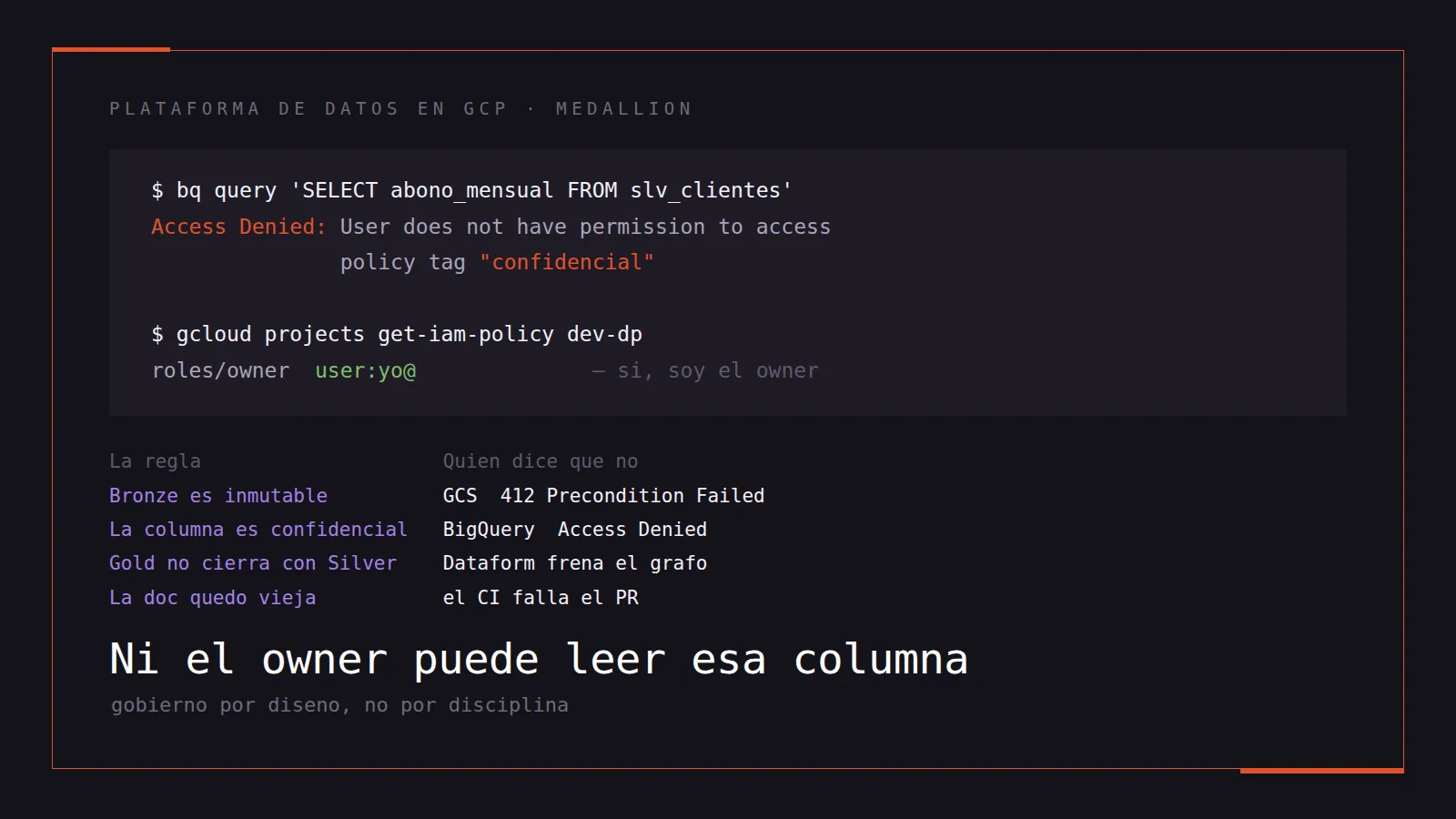
Not Even the Project Owner Can Read That Column
The thesis
A small or mid-sized organization’s data problem is almost never volume. It’s that the business logic lives scattered across scripts inside the BI tool: unversioned, untested, with no lineage. Four symptoms always show up together:
- Nobody can trace a number on a dashboard back to its origin.
- Failures are silent: a dashboard serves stale data for months without raising a single error.
- There’s no catalog, no glossary, no owners, and access control over sensitive data is the good faith of whoever built the dashboard.
- Ingestion overwrites history and drops rows to badly handled pagination.
All four have the same shape. There’s a rule everyone subscribes to, and nothing that enforces it.
“Bronze is never overwritten” is an agreement. “The dashboard only reads Gold” is an agreement. “Not everyone gets to see the billing column” is an agreement. An agreement holds until the Tuesday somebody is in a hurry.
So I built a data platform on GCP — Medallion, Terraform, Dataform — around a single design question, repeated for every rule I cared about: who says no, and what happens when someone tries anyway?
The two versions of every rule
| Rule | The discipline version | Who says no |
|---|---|---|
| Bronze is immutable | “the extractor appends” | GCS rejects the PUT with a 412 |
| The dashboard only reads Gold | permissions someone set once | The BI service account has no grant on Silver |
| This column is confidential | a comment in the model | BigQuery: Access Denied on policy tag |
| Gold never publishes a number that doesn’t reconcile | someone checks before the review | Dataform won’t build what depends on the failed assertion |
| The documentation is current | goodwill | CI fails the PR |
The middle column is what almost every repo has. The right one is the work.


architecture/gcp-data-platform/.The uncomfortable case: column-level control
There are two mechanisms in GCP that look alike and don’t compete. Confusing them is the most common mistake I’ve seen.
data_sensitivity label | Policy tag | |
|---|---|---|
| Applies to | the resource (dataset, bucket) | the column |
| Good for | inventory, cost attribution, search | blocking reads |
| Who applies it | Terraform | Dataform, in the model’s config |
| If you lack access | you still read everything | Access Denied on policy tag |
The label answers which resources touch sensitive data. It’s an inventory tag: useful for slicing cost in the billing export and for answering “who owns this” without reading Terraform. It prevents nothing.
The policy tag answers who can read this column, and BigQuery enforces the answer at query time.
What surprises you the first time is that a policy tag isn’t inherited from
project IAM. Without an explicit datacatalog.categoryFineGrainedReader
binding on that taxonomy level, nobody reads that column. Not even the project
owner.
It looks like an aggressive default and it’s the only correct one: access to sensitive data is granted, not inherited. Which is why the reader map starts empty:
readers_por_nivel = {} # on purposeA taxonomy born with everyone inside classifies nothing.
The consequence is worth saying out loud before you apply it: the first time, a
dashboard will break. A query that used to work starts returning
Access Denied on policy tag. That isn’t a bug in the module. It’s the first
time anyone has to decide whether that service account should see that column —
and leaving it out is a valid answer too.
The id that doesn’t exist until after apply
Here’s a seam I enjoyed solving.
Terraform creates the policy tag. Dataform applies it, in the model’s
config. But the tag id doesn’t exist until after apply, and it changes per
environment. Writing it into the .sqlx would mean the project can’t compile in
a fresh environment.
So it travels as a compilation var, from Terraform to Dataform:
// dataform/includes/constantes.js
const POLICY_TAGS = {
  restringido:  dataform.projectConfig.vars.policy_tag_restringido  || "",
  confidencial: dataform.projectConfig.vars.policy_tag_confidencial || "",
};

function sensibilidad(nivel) {
  const tag = POLICY_TAGS[nivel];
  if (tag === undefined) {
    throw new Error(`Unknown sensitivity level: ${nivel}`);
  }
  return tag ? [tag] : [];
}
And the model names the level, never the id:
abono_mensual: {
  description: "Recurring subscription fee, NUMERIC.",
  bigqueryPolicyTags: constantes.sensibilidad("confidencial")
}
The detail that matters is the || "". Empty is a valid state: while the
catalog isn’t applied, models compile and tag nothing. The temptation is the
opposite — drop in a fake id so it “works locally” — and it’s the worst option on
the table, because a non-existent policy tag doesn’t fail at compile time. It
fails on the apply against BigQuery, and by then it’s already merged.
It’s the same shape as the problem I wrote about yesterday: the error exists from the start, and the only thing you choose is when it surfaces. A fake id moves it from where it’s annoying to where it hurts.
Bronze isn’t overwritten because storage won’t allow it
The anti-pattern that motivates a Bronze layer is if_exists='replace': the
extractor runs, overwrites yesterday, and history stops being reconstructible
without anyone noticing.
The discipline version of the fix is “extractors append.” The version that holds on its own is two barriers for the same rule:
blob.upload_from_string(
    json.dumps({"_lineage": lineage, "records": records}, ensure_ascii=False),
    content_type="application/json",
    if_generation_match=0,
)
First, the object name is unique — timestamp plus uuid — so two runs don’t
collide. Second, if_generation_match=0 tells GCS the upload is only valid if
the object doesn’t exist; if it does, the API returns
412 Precondition Failed and the function blows up.
The second looks redundant as long as the first works. The day the name generator has a bug, the unique name stops being unique, and the precondition is the only thing standing between “we lost a day of history” and an exception in the logs. Immutability is guaranteed by storage, not by the discipline of whoever wrote the extractor.
The number that doesn’t reconcile never reaches the dashboard
gld_presupuesto_vs_real aggregates gld_ingresos_mensuales by segment. A join
can lie in two ways: filtering too much (you lose rows) or multiplying (you
duplicate them). Both produce a perfectly plausible number on a dashboard, and
neither produces an error.
The assertion compares the two totals, month by month:
FROM detalle
FULL OUTER JOIN agregado ON detalle.mes = agregado.mes
WHERE ABS(COALESCE(detalle.total, 0) - COALESCE(agregado.total, 0)) > 0.01
Two decisions inside those three lines. The comparison is per month, not
global, because a global total can match through compensation between two
months with opposite-sign errors. And the 0.01 tolerance is for NUMERIC
rounding, not a business margin of error: the day it needs raising, the tolerance
isn’t the problem.
What makes it a control rather than a log is what Dataform does when it fails: it doesn’t build what depends on that model. The pipeline stops before Gold instead of publishing a bad number and posting to a channel nobody reads.
What gets generated, and what doesn’t
The data dictionary comes out of the config blocks in the .sqlx files.
Describing the same thing twice guarantees one of the two versions is wrong:
python3 scripts/generar_diccionario.py --check # fails if it went staleThat --check runs in CI. If a model changes and nobody regenerated the
dictionary, the PR doesn’t pass. Those same descriptions are what Dataform
publishes into BigQuery and what the catalog picks up afterwards: one source,
three destinations.
The business glossary, on the other hand, is written by hand — and that’s correct.
The dictionary describes what the code does; the glossary describes what the
business decided. A column named ingreso_recurrente can be perfectly documented
and still leave open whether a paused contract counts. You can’t derive that from
the SQL, because the SQL is the consequence of the decision, not the decision.
Which is why every term records who signs off on it. A term without an owner is an opinion, and six months later nobody remembers which one.
That’s the limit of the method: automation moves the boundary of what can’t go stale. It doesn’t erase it.
When the convention loses
One case where the rule collided with someone else’s limit. The project ID by
convention is {environment}-{client}-{project}-gcp. Service account
account_ids derive from it, and GCP caps those at 30 characters. They don’t
fit.
Two ways out: shorten the convention everywhere, or admit GCP has the last word. I picked the second, on one condition — whoever hits it shouldn’t have to investigate anything.
validation {
  # The longest role is "dataform" (8). 30 - len("-sa-dataform") = 18.
  condition     = length("${var.sa_prefix}-sa-dataform") <= 30
  error_message = "sa_prefix too long: it exceeds the 30 characters GCP allows in an account_id. Set `gcp_project_id_override` in the environment's terraform.tfvars."
}
It fails at plan, before touching anything, and the message says what to write.
The discipline version of this was a paragraph in CONVENTIONS.md explaining the
limit — the one you read the day after you already broke something.
What isn’t there yet
Worth being explicit, because half of what I described above is validated design, not production:
- The catalog module compiles and validates against the provider, but has never been applied against a real project. The policy tag that not even the owner can read is how it’s documented to work, not a war story of mine.
- Bronze doesn’t land in BigQuery yet: the connectors drop JSON in GCS and the external table or load job is still missing.
- Both connectors are reference implementations, untested against a real API.
- Row-level security and authorized views live in the C4 model, not in Terraform.
workflowandschedulerare written and instantiated in no environment.
The day this gets applied against a real project, the part I expect to hurt is the policy tags. That it hurts is the point: it means somebody was reading a column we never decided they could read.
What I’m taking away
- A rule that depends on discipline isn’t a rule, it’s an intention. The useful question isn’t “is it documented?” but “what happens if someone does it anyway?”.
- The control worth having is the one that can say no to you. A policy tag the project owner can’t step around is worth more than any permission that cascades downward.
- Choose where the error surfaces. You never choose whether the error
exists; only whether it shows up in your environment or on the production
apply. A fake id so it compiles locally is that choice, made badly. - Generate everything you can, and accept what you can’t. Generated documentation can’t go stale; hand-written documentation can. What the business decides isn’t in the code, and pretending otherwise produces a glossary that lies.
- When a convention collides with someone else’s limit, don’t document the
limit. Make the
planfail with the message that says what to do.
None of this is specific to GCP. Terraform, Dataform and BigQuery are the vocabulary; the exercise is going rule by rule and deciding whether it lives in a document or in a mechanism. Every one you move costs more that day and stops costing on all the others.